
3D AOI Inspection Equipment
Contract Production utilises the latest advanced 3D AOI Inspection Technology to ensure precision, reliability and confidence in our PCB Assembly Processes
Request a Manufacturing Review
3D AOI Inspection Equipment – Precision, Reliability & Efficiency in PCB Inspection
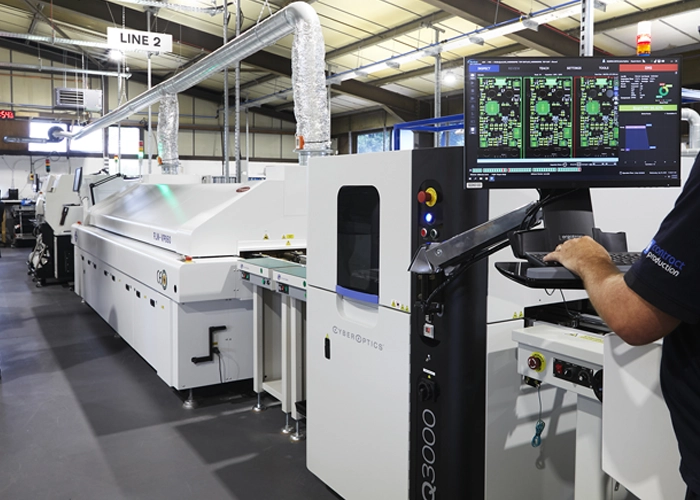
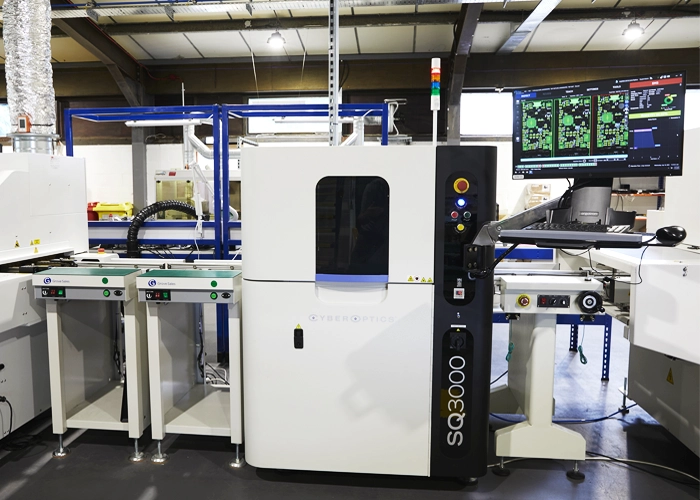
In today’s fast-paced electronics manufacturing industry, achieving precision and reliability in PCB assembly is crucial for producing high-quality products. Advanced 3D Automated Optical Inspection (AOI) technology is the cornerstone of modern PCB assembly inspection, offering unparalleled accuracy and efficiency. Our state-of-the-art Nordson SQ3000 3D AOI inspection equipment delivers comprehensive, real-time insights into every aspect of the PCB, ensuring flawless assembly and greatly reducing the risk of downstream defects.
With the ever-increasing complexity of electronic devices, it’s more important than ever to use advanced inspection technologies that guarantee reliability and precision in the final product. This page will explore the benefits, capabilities, and features of our 3D AOI technology and inspection equipment, and how it can helps to optimize the PCB assembly process.
What is 3D AOI Technology?
3D Automated Optical Inspection (AOI) is a cutting-edge technology used in the inspection of printed circuit board assemblies (PCBA’s) during the manufacturing process. Unlike traditional 2D AOI systems, 3D AOI utilises advanced imaging and measurement techniques to inspect the PCB from multiple angles and depths. This provides a more detailed, accurate, and comprehensive analysis of the board, allowing us to detect even the most subtle defects that may go unnoticed with traditional 2D inspection systems.
Key Features and Benefits of 3D AOI Technology
Enhanced Inspection Accuracy
- Precision Measurements: 3D AOI technology can measure the height, width, and volume of components on the PCB, resulting in a more precise and comprehensive inspection coverage than a 2D system. This enhanced coverage ensures that defects such as excess solder, starved solder joints, solder bridges, alignment errors, lifted leads and co-planarity issues are detected and addressed at source.
- Depth Information: 3D AOI systems can detect issues that are hidden in traditional 2D images by capturing depth and measurement information that helps improve inspection accuracy and reduce false call scenarios.
Comprehensive PCB Assembly Inspection Coverage
- Multi-Angle Views: By capturing images from various angles and depths, our 3D AOI system provides a comprehensive and detailed image of the entire PCB assembly, ensuring every SMT component and solder joint is verified to pre-set tolerances and standards.
Faster, Real-Time Inspection
- High-Speed Analysis: 3D AOI inspection equipment is designed for high-speed performance, allowing us to inspect boards in real-time and at higher speeds without compromising accuracy.
- Immediate Feedback: The system can instantly flag defects or inconsistencies and allow us to remedy any issues in process, reducing downtime and enhancing production efficiency.
Increased Productivity and Cost Efficiency
- Reduced Rework – Increased Efficiency: By identifying defects early in the manufacturing process our 3D AOI Technology reduces the need for costly rework, repairs, and material waste, resulting in higher yields and a more cost-effective PCB assembly process.

How 3D AOI Inspection Works
3D AOI inspection machines utilize advanced optics, high-definition cameras, and sophisticated algorithms to perform comprehensive inspections. Here’s how the process works:
High-Resolution Imaging
Unique MRS sensor technology generates high-resolution, reflection free images of the PCBA from multiple angles. These images are then fused together using 3D algorithms resulting in an ultra-high quality image of the assembled board.
Measurement and Analysis
Using advanced software, the 3D AOI system measures the dimensions and position of components, checks for solder joint quality and verifies component placement and alignment.
Comparison with CAD Data
The system compares the captured data with the original design and engineering files (CAM data) to ensure that all components are correctly placed and soldered.
Defect Detection
The system detects defects such as excess solder, solder starvation, misaligned components, solder bridges, lifted leads, missing components,, tombstoning, billboarding and co-planarity issues providing immediate feedback for corrective action and process improvement.
Reporting and Traceability
After the inspection is complete, the system generates detailed reports on any defects found, along with traceability data that can be used for quality control and process improvement purposes.
Frequently Asked Questions (FAQs)
How is 3D AOI different from 2D AOI?
Unlike 2D AOI, which relies solely on top-down imaging, 3D AOI captures depth information, allowing for precise viewing and measurement of component height, solder volume, and solder joint integrity. This results in better detection of issues such as lifted leads, solder bridges, excess/insufficient solder and co-planarity defects.
What types of defects can 3D AOI detect?
Our 3D AOI equipment can detect a wide range of defects, including:
- Misaligned, missing or incorrect components
- Soldering defects such as insufficient or excess solder
- Tombstoning / billboarding
- Solder bridges
- Coplanarity defects
- Bent or lifted leads
- Component polarity
What are the benefits of using 3D AOI inspection?
Key benefits of 3D AOI technology include:
- Enhanced imaging technology with Increased inspection accuracy and defect detection
- Faster, automated inspection for higher throughput
- Improved efficiency and first time yields
- Real-time feedback for process optimization
How fast is a 3D AOI inspection process?
The inspection speed depends on the complexity of the PCB and the resolution settings but our 3D AOI equipment is considerably faster than its 2D counterpart and is situated in-line for optimum process efficiency.
Does 3D AOI replace X-ray inspection in PCB assembly?
No, 3D AOI and X-ray inspection serve different purposes. While 3D AOI is excellent for detecting surface defects and misalignments, X-ray inspection is needed for hidden defects, such as those in Ball Grid Arrays (BGAs) or multilayer solder joints.
How does 3D AOI improve overall PCB manufacturing quality?
By detecting any potential defects early in the production process, 3D AOI ensures that any faulty PCBs are identified and corrected prior to moving on to downstream processes, improving production yields, process efficiency and product quality.