In today’s electronics landscape, the demand for smaller, faster, and more reliable devices is higher than ever. From compact smartphones and wearables to industrial IoT and aerospace systems, modern electronics require precision and high-density designs. Achieving this is made possible through Surface Mount Technology (SMT), the foundation of contemporary PCB assembly.
SMT enables components to be mounted directly on the surface of printed circuit boards (PCBs), eliminating the need for drilled holes. This approach allows for faster production, higher component density, cost efficiency, and enhanced reliability, making it the global standard for modern electronics manufacturing.
This comprehensive guide explores:
-
- What is Surface Mount Technology (SMT)?
- The SMT Manufacturing Process
- Key Advantages of SMT
- Design Considerations for SMT (DFM for SMT)
- SMT vs. Through-Hole Technology (THT)
- Quality Assurance in SMT Assembly
- Applications Across Industries
- Common Challenges in SMT Manufacturing
- Frequently Asked Questions (FAQs)
- Why Partnering with a UK Manufacturer Matters
- Conclusion
What Is Surface Mount Technology (SMT)?
Surface Mount Technology (SMT) involves placing electronic components, called Surface Mount Devices (SMDs), directly onto the surface of a PCB. Unlike traditional Through-Hole Technology (THT), which requires component leads to pass through drilled holes, SMT streamlines assembly, enabling more compact designs and higher production efficiency.
Key benefits of SMT include:
-
-
Miniaturisation: Smaller, lighter components enable compact and portable devices.
-
Speed: Automated assembly lines can place tens of thousands of components per hour.
-
Reliability: Consistent solder joints and reduced human error.
-
Cost-efficiency: Reduced assembly time and material use.
-
Modern SMT lines can handle complex multi-layer boards, high-density layouts, and mixed-technology assemblies with precision and repeatability.
The SMT Manufacturing Process
The SMT process is a combination of automation, computer control, and skilled oversight. Key stages include:
1. Solder Paste Application
A precise layer of solder paste is applied to the PCB pads using stencils. Accurate application is critical to prevent defects like solder bridges or open joints.
2. Component Placement
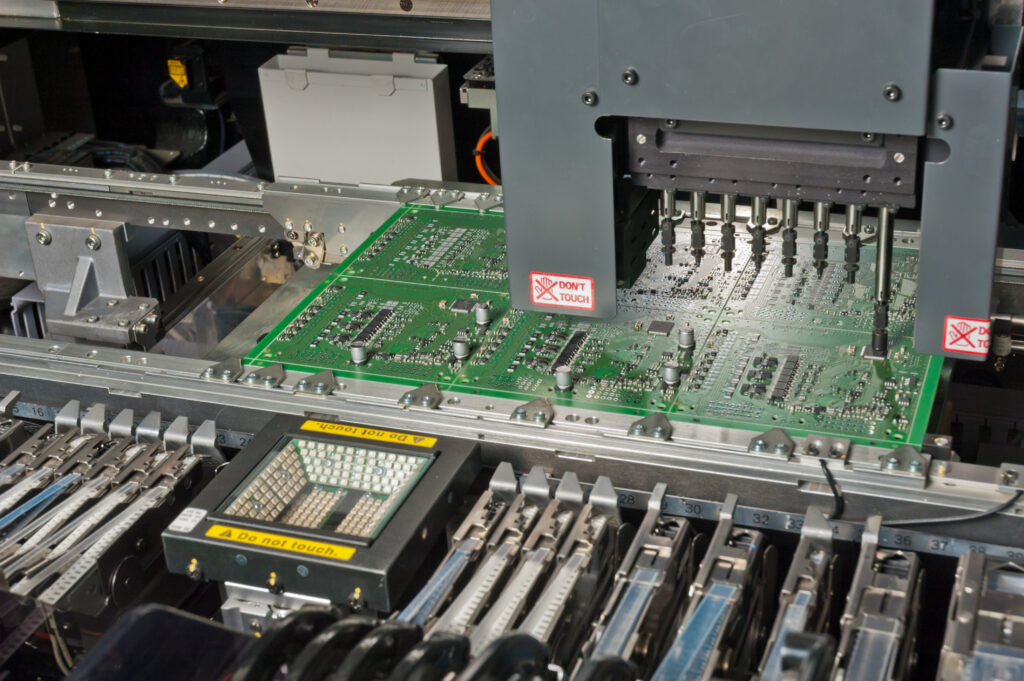
Pick-and-place machines position components onto the solder-pasted pads with micrometer-level accuracy. Components from tiny 01005 resistors to complex BGAs are placed at high speed, often exceeding 50,000 components per hour.
3. Reflow Soldering
The PCB passes through a reflow oven where solder paste melts and forms secure connections. Multi-zone thermal profiling ensures precise temperature control to prevent solder defects and component damage.
4. Inspection & Quality Control
Boards undergo layered inspection to verify assembly quality:
-
-
Automated Optical Inspection (AOI): Detects misaligned, missing, or bridged components.
-
X-Ray Inspection: Examines hidden solder joints in BGAs and multi-layer boards.
-
Functional Testing: Simulates real-world operation to verify performance.
-
This multi-stage approach ensures that assemblies meet design specifications and perform reliably in the field.
Key Advantages of SMT
SMT offers numerous benefits for modern electronics manufacturing:
- Miniaturisation: Enables compact designs with higher component density.
- High-Speed Automation: Reduces production time and cost.
- Cost Efficiency: Eliminates drilling, minimizes manual assembly, and supports high-volume production.
- Improved Electrical Performance: Shorter leads reduce inductance and resistance, enhancing high-frequency signals.
- Consistent Quality: Automated processes reduce variability caused by human error.
Design Considerations for SMT (DFM)
To achieve optimal results, SMT designs should follow Design for Manufacture (DFM) guidelines:
-
-
Component Spacing: Adequate clearance for soldering and rework.
-
Pad Design: Correct pad size and shape for strong solder joints.
-
Thermal Management: Even heat distribution prevents PCB warping.
-
Component Orientation: Consistent placement facilitates pick-and-place programming.
-
Panelisation: Grouping PCBs into panels improves handling and throughput.
-
Early DFM reviews ensure higher yields, reduced rework, and faster time-to-market.
SMT vs. Through-Hole Technology (THT)
| Feature | SMT | THT |
| Assembly Speed | Very fast, automated | Slower, often manual |
| Board Density | High, compact | Lower |
| Mechanical Strength | Moderate | High (for large components) |
| Cost | Lower for high-volume runs | Higher due to drilling |
| Best Use | Consumer, industrial, compact devices | Rugged and high-power designs |
Hybrid assemblies are common, combining SMT for small components with THT for connectors or power modules.
Quality Assurance in SMT Assembly
High-quality SMT assembly relies on rigorous process control and inspection:
-
-
Solder paste verification using automated 3D scanners
-
AOI checks post-placement and reflow
-
X-ray imaging for BGAs and QFNs
-
Functional and in-circuit testing
-
ESD-controlled environments for sensitive components
-
This ensures reliability, performance, and repeatability, whether for prototypes or large-scale production runs.
Learn more about PCB Testing & QA
Applications Across Industries
SMT is widely used in:
-
-
Consumer Electronics: Smartphones, wearables, laptops, TVs
-
Automotive: ECUs, sensors, control modules
-
Industrial Automation: PLCs, motor drives, instrumentation
-
Aerospace & Defence: Compact, robust control systems
-
Medical Devices: Portable diagnostics, monitoring equipment
-
Common Challenges in SMT Manufacturing
Despite its advantages, SMT requires careful handling of:
-
-
Miniaturisation Complexity: Handling 01005 or smaller components
-
Thermal Stress: Precise reflow to prevent damage
-
Moisture Sensitivity: Proper storage and baking of components
-
Inspection Difficulty: Hidden joints require X-ray verification
-
Modern SMT facilities overcome these challenges through advanced automation, skilled engineers, and strict process control.
Frequently Asked Questions (FAQs)
Q1: What is the main benefit of SMT over THT?
SMT enables faster, more cost-effective, and space-efficient assembly, ideal for compact electronics.
Q2: Can SMT and THT be used together?
Yes. Hybrid designs use SMT for small components and THT for connectors or power parts.
Q3: How small can SMT components be?
Standard SMT lines handle components as small as 01005, smaller than a grain of sand, with precise placement.
Q4: Is SMT suitable for high-reliability industries?
Yes. With proper design, inspection, and process control, SMT meets stringent aerospace, automotive, and medical standards.
Q5: How is SMT quality ensured?
Through a combination of AOI/X-ray inspection, functional testing, IPC-certified technicians, and ISO-compliant quality management systems.
Q6: How does SMT affect production cost and speed?
Automated placement and reflow soldering reduce labour costs, increase throughput, and support high-volume, cost-efficient manufacturing.
Q7: What is the difference between SMT and THT in durability?
THT provides higher mechanical strength for large components, while SMT allows for denser layouts and lighter boards without sacrificing reliability for small devices.
Q8: Can SMT accommodate mixed technologies?
Yes. SMT can be integrated with THT in hybrid assemblies for complex designs, enabling optimal performance and flexibility.
Why Partner with a UK SMT Manufacturing Specialist
Partnering with an experienced SMT manufacturer ensures precision, reliability, and consistent results from prototype to full-scale production. Local UK facilities offer:
-
-
Advanced SMT lines capable of fine-pitch and mixed-technology assembly
-
Full inspection and quality assurance (AOI, X-ray, functional testing)
-
Engineering support for DFM reviews and design optimisation
-
Flexible production volumes, from prototypes to mass production
-
Fast communication, traceability, and local accountability
-
A trusted UK partner combines automation, expertise, and rigorous quality control to deliver electronics that perform flawlessly in the field.
Conclusion
Surface Mount Technology represents the pinnacle of modern electronics assembly, offering precision, speed, and efficiency for compact, high-performance devices. From smartphones to aerospace and industrial systems, SMT enables miniaturisation and consistent performance in demanding applications.
With decades of experience, advanced equipment, and a commitment to excellence, Contract Production Ltd provides complete SMT assembly solutions, supporting customers from prototyping to large-scale production. State-of-the-art UK-based facility ensures quality, reliability, and traceability every step of the way.
Contact Contract Production Ltd at 01751 475950 or sales@contractproduction.co.uk to discuss your SMT assembly requirements or request a tailored quote.